


Google has spent much of 2026 pushing its search engine towards an AI-first future. But with users questioning the value of AI-generated answers, businesses concerned about falling website traffic and more than $500 billion wiped from parent company Alphabet’s market value in a single day, it’s worth asking a simple question.
Is Google making Search better, or is it risking the very business that made it so successful?
It’s a question that would have seemed almost unthinkable a few years ago. Google has dominated online search for more than two decades, largely because it became very good at helping people find what they were looking for.
Now, in its determination to compete in artificial intelligence, it is fundamentally changing how that experience works.
And the consequences are becoming increasingly apparent.
From finding websites to providing answers
Traditionally, Google’s business model has been relatively straightforward.
Someone searches for something. Google provides a selection of relevant websites, alongside paid advertisements. The user chooses where to go next.
Businesses invest in search engine optimisation (SEO) to appear in the organic results, or pay for advertising through Google Ads. Google makes money from the advertising, businesses attract potential customers and users find the information they need.
It has been an extraordinarily successful arrangement.
AI is changing that relationship.
Rather than simply helping people find information, Google increasingly wants to provide the information itself.
AI Overviews generate answers directly within search results, drawing on information from websites. AI Mode takes this further, allowing people to ask follow-up questions and have more conversational interactions without necessarily visiting another website.
During its October 2026 earnings announcement, Google described its ambition as creating one seamless experience combining AI Overviews, AI Mode and traditional Search.
From a technological perspective, that is an impressive ambition.
From a commercial perspective, however, it raises some difficult questions.
What happens to the businesses providing the information? What happens to the advertising model? And, perhaps most importantly, is this actually what users want?
The $500 billion warning
On 29 October 2026, Alphabet suffered a historic stock market decline, losing more than $500 billion in market value.
It would be misleading to attribute that entire fall to AI Overviews.
Investors were reacting to a combination of disappointing financial results, slowing advertising growth, substantial spending on AI infrastructure and concerns about how quickly that investment will generate returns.
Nevertheless, there was a particularly revealing development.
Google acknowledged that increasing use of AI Mode was contributing to a slowdown in search advertising growth.
The figures tell an interesting story.
Google’s search advertising revenue grew by 19% year on year in the first quarter of 2026, 17% in the second and 12% in the third.
Revenue is still growing, but the rate of growth is slowing considerably.
Meanwhile, Alphabet reported negative free cash flow of $9.1 billion for the quarter, as it continued investing heavily in the infrastructure required to support its AI ambitions.
In other words, Google is spending enormous amounts developing a new search experience that, at least currently, generates less advertising revenue than its traditional model.
That doesn’t necessarily mean the strategy will fail.
But it does suggest that replacing a highly profitable business model with something technologically impressive is not automatically a commercial success.
Are AI Overviews actually helping users?
This is where the discussion becomes particularly interesting.
AI-generated answers can be extremely useful. If someone wants a quick explanation, a summary of a complicated subject or help understanding a particular issue, AI can save considerable time.
But not every search needs an AI-generated answer.
Sometimes people simply want to find a website, compare different sources or explore the options themselves.
Google’s AI Overviews are now a core part of Search and cannot be permanently switched off through the standard settings. Users can select the Web filter to see traditional text-based results, but that requires an additional choice.
There is also evidence that attitudes towards AI summaries are mixed.
Research published by Pew Research Center in October 2025 found that, among US adults who had encountered AI summaries, only 20% considered them extremely or very useful. Another 52% found them somewhat useful, while 28% considered them not particularly useful or not useful at all.
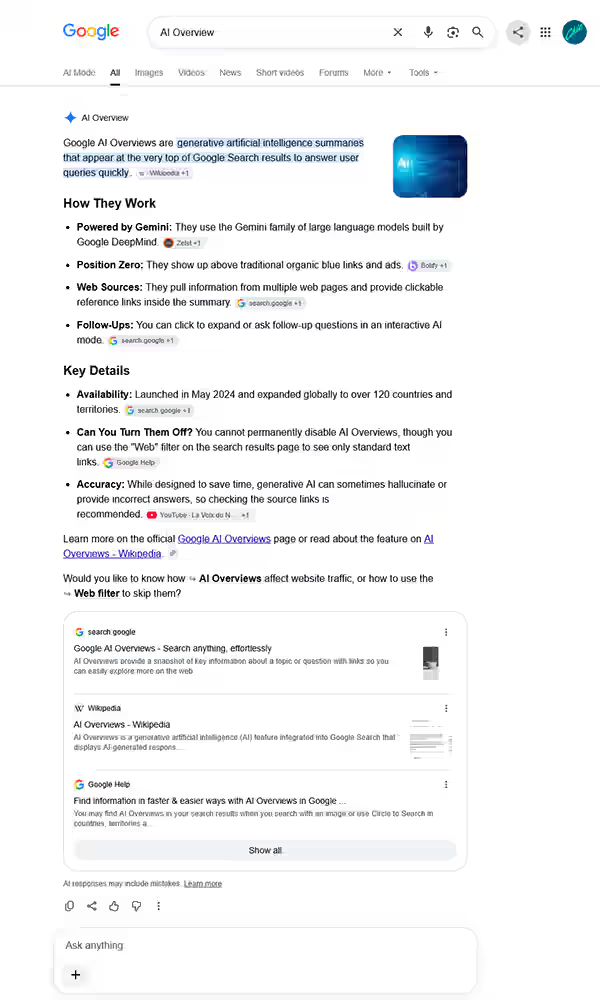
That doesn’t mean people are rejecting AI search. In fact, Google’s own figures suggest that adoption is substantial.
But it does raise a question about the difference between people using a feature and people actively wanting it.
If an AI Overview appears at the top of your search results, reading it doesn’t necessarily mean you would have chosen that experience.
Perhaps the best search engine isn’t the one that uses the most AI. It’s the one that best understands when AI is actually useful.
What happens to the websites providing the answers?
For businesses, this may be the most important part of the debate.
Google’s traditional search model gave websites an opportunity to attract visitors by providing relevant, useful information.
That created an incentive for businesses, publishers and organisations to invest in quality content.
AI Overviews potentially change that arrangement.
If Google can extract and summarise the information someone needs, the user may never visit the website that originally provided it.
Research published by Pew Research Center in July 2025 found that users clicked a traditional search result in just 8% of visits where an AI summary appeared, compared with 15% when no AI summary was present.
Only 1% of visits featuring an AI summary resulted in a click on a source cited within that summary.
These figures do not prove that AI Overviews caused every reduction in clicks. Different types of searches may produce different user behaviour.
However, they demonstrate why businesses and publishers are concerned.
A company could invest time and money producing useful content, have Google use that content to help answer someone’s question, and receive little or no traffic in return.
Google argues that AI search creates new opportunities for discovery and that people are asking more questions than before.
Both things could be true.
But increased search activity is not necessarily the same as increased commercial opportunity for the websites that make those answers possible.
And if businesses eventually see diminishing returns from producing quality content, where will the information powering those AI answers come from?
Is Google undermining its own advertising business?
Google has another challenge.
For years, its pay-per-click advertising model has worked because businesses were prepared to pay for relevant visitors.
An advertiser bids to appear when someone searches for a particular product or service. If the advertisement attracts a click, the business pays Google.
AI changes how people interact with those results.
If users receive answers without clicking through, traditional advertising opportunities may become less valuable.
Google is already responding by developing new advertising formats within AI Mode and AI Overviews.
On 28 October, it announced plans to expand AI Mode advertising into additional countries, with the UK among the markets planned for later in 2026.
Google says early results are encouraging.
It is entirely possible that conversational advertising will eventually become highly effective, particularly when someone is actively researching a purchase.
But there is a difference between proving that advertising can work within an AI experience and demonstrating that it can replace the economics of traditional search.
Google now faces the challenge of maintaining its advertising revenues while encouraging people to interact with search results in a fundamentally different way.
It is a difficult balancing act.
Could Google have taken a different approach?
There is an obvious counterargument.
Google couldn’t simply ignore artificial intelligence.
People are increasingly using services such as ChatGPT and other AI assistants to research subjects, compare options and find information.
Had Google refused to evolve, it might have risked losing users to competitors.
That is a legitimate strategic concern.
But there is a difference between incorporating AI into Search and making AI the dominant experience.
Google could arguably have placed greater emphasis on user choice, making it easier to move between traditional results and AI-generated answers according to what someone actually wants.
The technology would still be available. Google would still be competing in AI. But users would have more control over how they searched.
The risk with the current direction is that Google becomes so focused on defending itself against emerging competitors that it weakens some of the things its existing users and advertisers already value.
What does this mean for SMEs?
For small and medium-sized businesses, the answer isn’t to abandon Google or immediately rewrite their entire marketing strategy around AI.
Google remains an enormously important channel for attracting potential customers.
Search advertising revenue is still growing, and Google continues to report substantial demand for its services.
But businesses should recognise that the way people discover information is changing.
There are several practical implications.
First, focus on commercial outcomes rather than rankings alone.
Appearing prominently in search results is valuable, but what matters is whether that visibility generates enquiries, sales and profitable customers.
Second, make your content genuinely useful.
Original expertise, customer experiences, practical examples and information that answers real questions remain valuable. Generic content that simply repeats what is already available elsewhere offers increasingly little differentiation.
Third, don’t become entirely dependent on one source of traffic.
Search remains important, but so do email marketing, customer retention, referrals, direct relationships and other relevant marketing channels.
Finally, measure what is changing.
Review organic traffic, enquiries, conversion rates and the return on your paid advertising. Look at trends over time rather than reacting to individual fluctuations.
The objective should not be to chase every new development in search technology.
It should be to understand how customers find and choose your business, and adapt your marketing accordingly.
So, is Google’s AI-first strategy a mistake?
It’s too early to say that Google’s strategy has failed.
The company is still growing, AI adoption is substantial, and its technology continues to develop rapidly.
Google may eventually create an AI-powered search experience that users prefer and advertisers find just as commercially valuable as traditional search.
But the events of October 2026 have exposed a significant challenge.
Google has built an enormously successful business by connecting people with information and businesses with potential customers.
Now it is investing heavily in technology that could fundamentally change both relationships.
Perhaps that change is inevitable.
But innovation should improve the experience and deliver genuine value, not simply demonstrate that a business can deploy the latest technology.
Google became successful because it was exceptionally good at helping people find what they wanted. The question now is whether it can remain successful if it starts deciding how people should find it.
For SMEs, there’s a wider marketing lesson here.
New technology can create opportunities, but it should never become the strategy itself.
Start with what your customers need. Understand what works. Then choose the technology and channels that help you deliver it.
Clarity first. Activity second.
Chic Marketing helps SMEs develop practical marketing strategies that attract new customers and build stronger relationships with existing ones. If you’re concerned about how changes to Google Search could affect your business, get in touch.